Along with our professional knowledge and skills, we bring our whole selves to work. Our thoughts, feelings, automatic reactions, habits, strengths and the places where we still struggle. We also bring the way we act when things are going well – and what happens when pressure starts to build.
At work, self-leadership is often narrowed down to time management, productivity, motivation and goals. These are important. But there is a deeper layer that begins earlier.
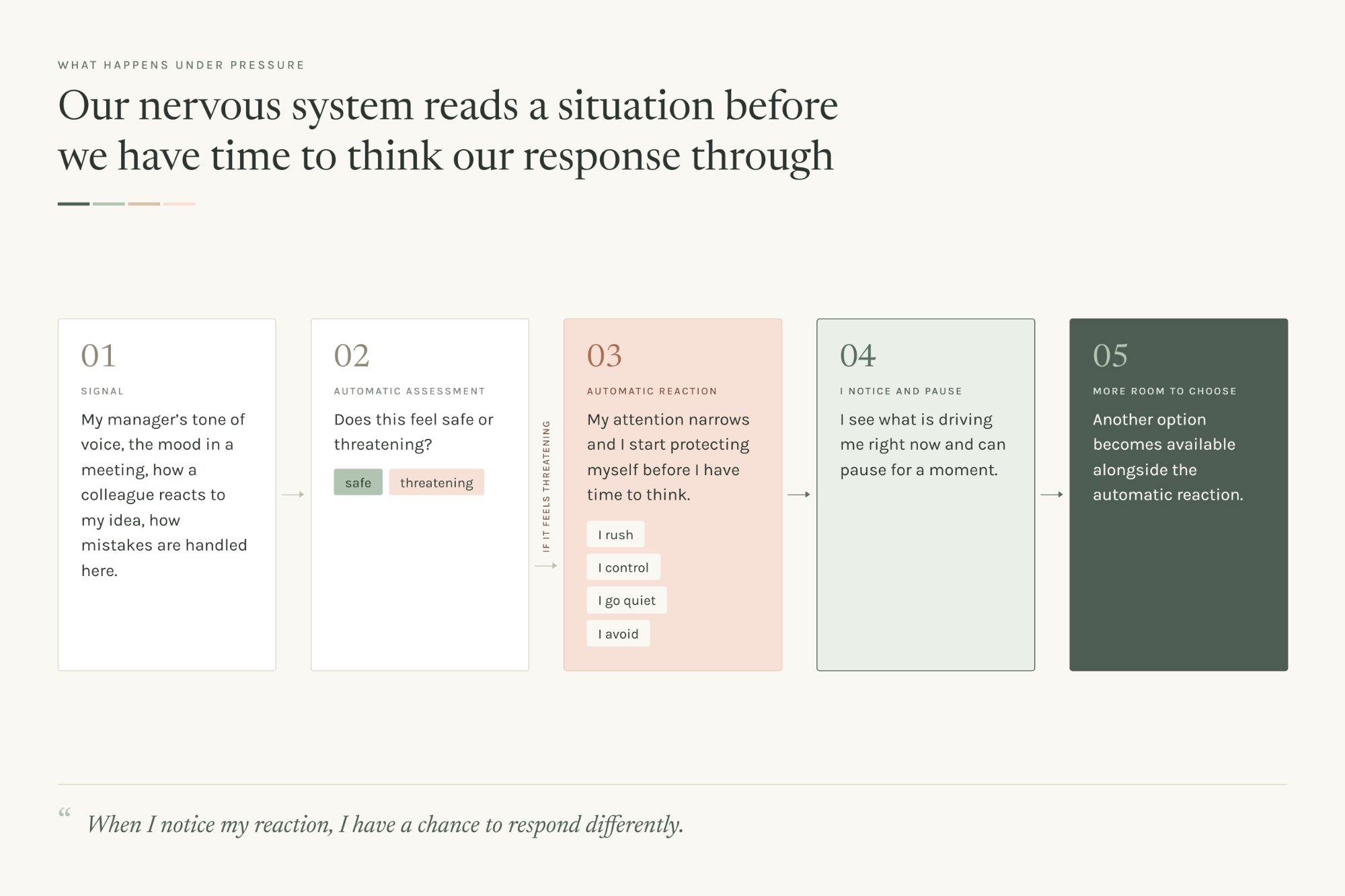
Our autonomic nervous system constantly takes in signals from the environment and from other people. It assesses whether a situation feels safe or threatening, and much of this happens automatically. This is why two people can experience the same situation very differently. An unexpected question from a leader may feel like an invitation to think together for one person, while another may hear it as a sign that they have done something wrong. When the nervous system senses a threat, our focus may narrow and we may start protecting ourselves – by rushing, controlling, going quiet or avoiding the situation – before we have had time to think our reaction through.
Do I notice what is happening inside me? Can I recognise the moment when pressure makes me speed up, take more control, avoid something or hold myself back? Can I tell the difference between a clear decision and a reaction driven by pressure or an old automatic pattern?
Only when I notice what is happening do I have a real chance to respond differently.
At work, we respond to more than tasks
We do not only respond to the work in front of us. We also notice a leader's tone of voice, the atmosphere in a meeting, a colleague's small reaction to our idea and the way people respond to mistakes or different opinions. All of this affects whether someone feels able to share an idea, ask for help or raise a problem while it is still small.
This is why self-leadership is not only about individual effectiveness. It directly affects collaboration, leadership and the culture people experience in a team every day.
Do we develop people or only give them more tools?
Organisations invest a great deal in development. People are taught new ways of working, time management, planning and leadership skills. But the ability to understand ourselves often receives less attention. I am not talking about another technique for pushing ourselves to work harder. I mean the ability to notice what is driving us in a particular situation – and to see that there is usually another possible response alongside the automatic one.
If we do not notice that pressure has pulled us into an old pattern, it is very difficult to do anything differently.
A leader leads people – and is one of them
A leader's role usually includes goals, strategy, plans and results. But much of everyday leadership is about how people actually behave in different situations.
Why does one person withdraw from conflict while another becomes confrontational? Why does a highly capable employee suddenly go quiet? Why do ideas grow in one team while people in another quickly learn that it is safer to keep their thoughts to themselves?
It is also worth looking at the leader. Leaders have automatic reactions too. Under pressure, a leader may start controlling more, postpone a difficult conversation or react more strongly than the situation requires.
Leading others begins, to a large extent, with noticing and managing ourselves. Not because a leader should always remain calm, but because they need to take responsibility for the effect they have on others.
Psychological safety does not mean everyone feels comfortable
Every team will face misunderstandings, tension and disagreement. These cannot and should not be avoided completely. A safe working environment is one where people can talk about problems before they become bigger. It is a place where someone can ask a question, make a mistake, disagree or say, "I don't know."
A leader's reactions play an important role here. What happens when an employee disagrees, makes a mistake or raises a problem the leader does not know how to solve? Teams learn a great deal from the way their leader responds in those moments.
Self-leadership is not only an individual responsibility
It would be too easy to place all the responsibility on the employee. The environment, the leader and the relationships within a team affect people. We can teach someone self-leadership, but if they work in a place where mistakes are punished or different opinions are dismissed, they will adjust to that reality. They may stop asking questions or keep ideas to themselves – not because they lack knowledge, but because of what experience has taught them.
This is where conscious self-leadership and a psychologically safe workplace meet. We need both.
What does this give an organisation?
The goal of self-leadership is not to reach a state where nothing affects us. We are human. Pressure and emotions are part of working life. What matters is what happens next. Can a person recognise what is happening, pause for a moment and notice what is driving their response? If even one other option appears alongside the automatic reaction, there is already more room to choose.
This may mean thinking more clearly in a difficult situation, receiving feedback without immediately becoming defensive, asking for help or speaking up. At team level, it may help people discuss problems before they grow into conflicts.
Self-leadership as a core workplace skill
The more I have learned about how people function, the more differently I have started to view my own 15+ years as a leader. Many situations look different with the knowledge I have today. I notice more of what may have been happening beneath visible behaviour – and how the leader's own reactions may have shaped the situation.
This is the perspective I want to bring into more organisations through my work. A form of self-leadership that is not about getting more out of people, but about helping them understand themselves better.
An organisation is not only made up of strategies, processes and goals. Behind all of them are people. And people do not leave themselves at the door when they start work.
If you feel this side of self-leadership could be developed more consciously in your team or organisation, you are welcome to get in touch.